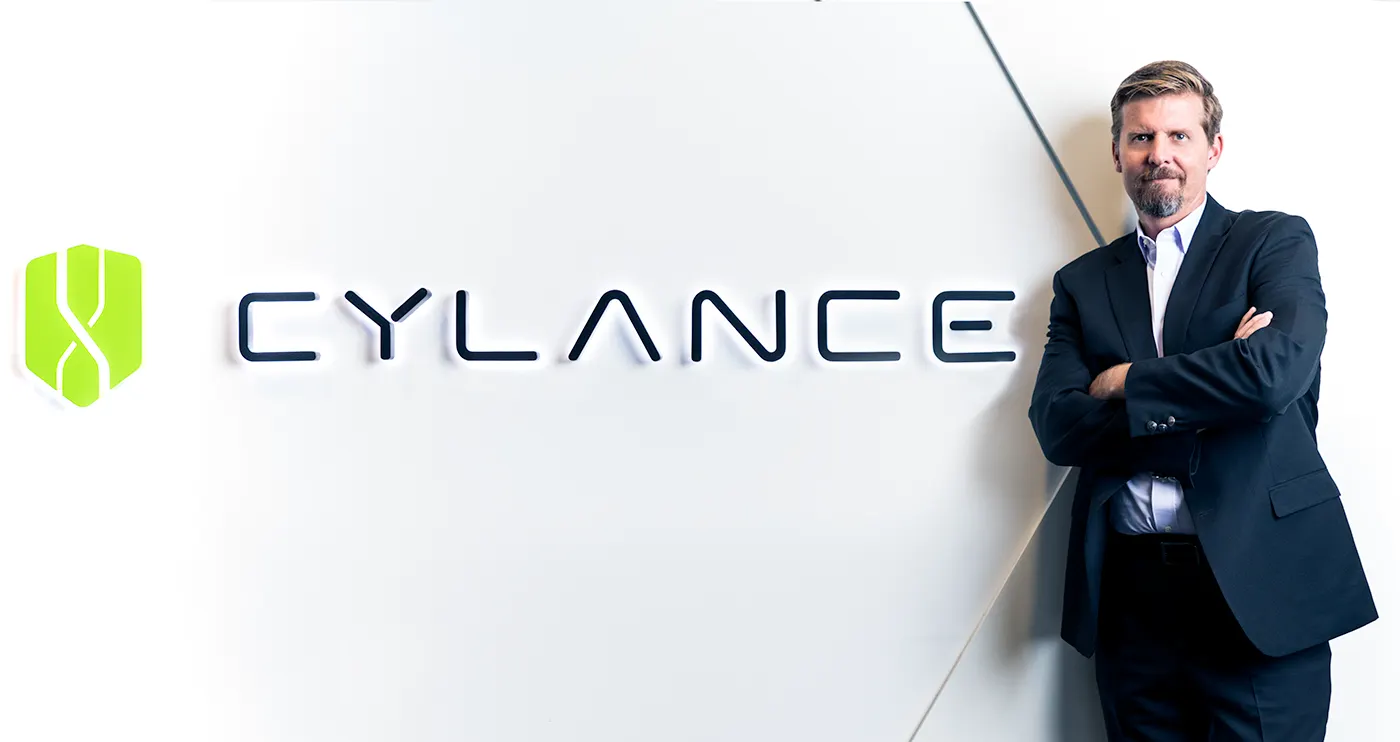
Stuart McClure, Cylance
Stuart McClure, Cylance
Written by DFJ
The idea of protecting people who can’t protect themselves just stuck with me. When I hit on cybersecurity, it felt like a natural home, trying to protect the world from becoming victimized.
Some events change the course of your life. For Stuart McClure, it was the day he almost died.
When he was 19, McClure and his family were flying to Australia when the door on their Boeing 747–122 suddenly blew open, sucking several first-class passengers out of the plane. Before boarding the flight, his family had turned down an offer to upgrade to first-class because they would have had to sit separately.
McClure later learned that an easily-preventable design flaw had caused the tragedy. The revelation also informed his decision to forge a career in security to help protect people against cyberattacks.
After a couple of startups — one that McAfee acquired for $86 million in 2004 — McClure co-founded Cylance in 2012 with the idea of using tools such as machine learning, algorithmic science and artificial intelligence to prevent, rather than reactively detect, viruses and malware.
McClure spoke with us recently to reflect on what has been a remarkable life journey.
Q: Where are you from?
Several places. I split my childhood between Los Angeles, Guam, Hawaii and Colorado.
Q: So either one of your parents worked in the military, the Foreign Service or was a spy.
Ha. No, though my father was retired Navy before we moved to Guam. He was recruited to help improve the economic development of the Mariana Island region. The US government wanted to stabilize the area, post-Korea, and he was put in charge of doing all that — not through a government entity, but through a consultancy.
Q: What was it like moving so frequently from place to place? Was it a drag for a kid having to start over each time?
It was exciting to see new and different places all the time. After a while, I got used to being in a school for only a year and moving on. I think that’s why I tend to be comfortable with unpredictability. My wife is my counter-balance however, more planned and prepared, so we balance each other out quite nicely.
Q: But it’s hard to make an adjustment. What was the hardest part for you?
The hard part was always being “the new kid” which meant it was hard to make friends or I would constantly get bullied and picked on. The plus side was I learned how to make friends in almost any social circle. I also learned to run really, really fast to avoid getting beat up. And to get even faster, I learned how to ride bicycles really, really fast and became a successful amateur cyclist.
Q: I read that you aspired to become the next Greg LeMond?
That’s right. He was my hero. Later on, I wound up going to Colorado to train at the Olympic Training Center for cycling to get to the 1988 Seoul games. I ended up not making the team, but I definitely trained for the trials.
Q: Did you ever get to meet him?
I met Greg twice. But my first interaction was with his wife Kathy, who responded to a letter that I wrote to Greg when I was living in Guam, telling him that I was an aspiring cyclist and wanted to be just like him when I grew up. He was so busy traveling that Kathy took the time to write three postcards full of really inspirational, “don’t give up, this is fantastic” kind of stuff to me. It really meant a lot to a 12-year-old that somebody would take the time to care about a person that they didn’t even know.
Q: How did you wind up in tech?
When I went to Boulder, I didn’t know what I really wanted to do professionally. I gravitated toward the classes that seemed interesting — which ended up being psychology and philosophy. But in my junior year, I found myself asking what the heck I was going to do with a philosophy or psych degree. So, I decided to take some computer classes in programming.
Q: Had you been exposed to technology previously?
I had taken a computing class in high school and really liked it. Later on, I had different jobs supporting computers, servers and networks, but until then, I hadn’t had much experience programming. I just fell in love with the computer science classes in college. I was so close to getting the psych and philosophy degrees, that I just decided to do one more semester and graduated in 1991 with a double major in psych and philosophy and a minor in computer science applications.
Q: Your decision on a career choice also links back to what was, literally, a near death experience you had on an airplane. Can you talk about the accident?
Sure. I was about to turn 20 and I was flying to Sydney, Australia with my younger brother and my mother. Because of a design flaw in the plane, the front cargo door opened in mid-flight. The resulting rapid decompression ripped a 40 by 20 foot hole in the side of the plane, sending nine people to their deaths. I will always feel an extreme sense of loss and empathy for those souls.
Q: That must have been frightening.
We all thought we were going to die, that it was just a matter of seconds or minutes before we would hit the ocean and tear into a thousand pieces. Something happens to a human brain when you know — not just think — but actually know that you are going to die. It’s just a question of how much time you have left. When we survived and landed, the shock back into reality was very difficult for me. What affected me so much was the fact that some of the passengers did not make it. And we would have been in a couple of the seats that got ripped out of the plane had we made a different choice.
It was survivor’s remorse. We survived and those souls didn’t — and for totally random reasons. My brother, mother and I were offered upgrades to the business class section. Had we taken those upgrades, at least two of us would have been gone.
Q: And how did that impact your thinking about what you wanted to do with the rest of your life?
As I investigated the accident, I found that it was entirely avoidable. The airline had known about the design flaw in the cargo door and been given notices that they were required to fix it. But they had not fixed it. To me, that was a travesty. And it just fused into my DNA that I can’t let people become victims for no reason. The idea of protecting people who can’t protect themselves just stuck with me. When I hit on cybersecurity, it felt like a natural home, trying to protect the world from becoming victimized.
Q: After college, you did a stint as a tech journalist?
Yeah, I was writing and editing articles for InfoWorld and later helped run their test center. I also had a weekly column with Joel Scambray called “Security Watch”. Man, that deadline was hard — every week for three years.
Q: I’m glad to learn that at least one former journalist has done well. But what led you to become an entrepreneur?
I realized that I had a knack for building something from scratch. I had a consultancy but I wanted to take my knowledge of hacking to help organizations protect against attackers. I wrote a book called “Hacking Exposed” and then set out to build a company that could leverage that book. I built technology that automatically broke into systems and then reported the vulnerabilities so administrators could fix the problems.
Q: You stuck around after McAfee bought Foundstone but you later became famous — or infamous — for telling the world that you didn’t use anti-virus software? That takes brass.
It does. But I have an anaphylactic response to untruths. I was asked to do a talk at the Rochester Institute of Technology. At the end of my presentation, a student asked me to show him my system tray, he said he wanted to know what I ran on my computer to protect myself. I looked at the front row and there’s the head of worldwide sales for McAfee sitting there. I’m like, you’ve got to be kidding me. Anyway, I said, “Look I don’t need to show you my system tray, I will tell you that I don’t use any security products and I haven’t since 1995.” This was in 2004.
Q: Wouldn’t most computer users find themselves getting into trouble taking that advice?
Yes. But I’m not 99% of the world. I knew what to look for and knew how to prevent these attacks. After answering this question once or twice a week for eight years, I thought to myself, why can’t we program a computer to think like me. To look for things just like me. I’d somehow been able to prevent zero-day attacks, left and right, so why can’t we program software to do that same thing? That’s how the idea behind Cylance came about.
Q: Over the course of your career, what have you learned about yourself that came as a surprise?
I always thought speed was of the essence. What I’ve discovered in making quick decisions is that while it might be good for the moment, it might not be good for the long-term. So for any sort of decision, I now take to heart the old Chinese proverb about how a moment of emotion being held can save 100 years of pain. I think about things more and reflect about them a little more and open up to my advisors to ask what they think because we all have blind spots.
Q: Is there anything that your employees will be really amazed to learn about you?
One good, one bad. The good one is I actually love to draw, sketch and paint. It allows me to escape. The bad one is that I’m addicted to Clash Royale on my smartphone. I don’t know why, but I’m obsessed with getting better at it.
Q: Who do you most admire?
Without a doubt, it’s my wife. She is so smart, strong, and beautiful. She was diagnosed with Lupus right after we met and she has managed that as well as a career and raising four kids. She is amazing.
Q: Do you have a favorite saying?
I use a lot of them but one that I’ve tried to pattern my career on is what Harry Truman said: You can accomplish a great many things as long as you don’t care who gets the credit. To me that’s really who I am at my essence. I really don’t care who gets the credit — just as long as we all win. That’s what I want.
Q: What are you reading these days?
It’s a book written by Anant Karnik (the father of Cylance’s head of engineering) about the Kashmir Princess. It’s a fascinating story. He was one of three people who survived the bombing of an Air India charter flight. It was an assassination attempt against Zhou Enlai in 1955, who was scheduled to board the plane but changed his flight plans at the last minute.
Q: What’s your favorite movie?
Groundhog Day. Because it so represents our life, living the same day over and over, without all its pain and suffering, until we change who we are. Then we find true happiness.
Q: You’re the second person interviewed for DFJ’s Founder Story series who chose that movie. So did Vince Passione of LendKey.
I love “repeating day” movies. It’s the “never give up” part about trying to change and better yourself and make progress in life. That message appeals to me.
Written by DFJ
The idea of protecting people who can’t protect themselves just stuck with me. When I hit on cybersecurity, it felt like a natural home, trying to protect the world from becoming victimized.
Some events change the course of your life. For Stuart McClure, it was the day he almost died.
When he was 19, McClure and his family were flying to Australia when the door on their Boeing 747–122 suddenly blew open, sucking several first-class passengers out of the plane. Before boarding the flight, his family had turned down an offer to upgrade to first-class because they would have had to sit separately.
McClure later learned that an easily-preventable design flaw had caused the tragedy. The revelation also informed his decision to forge a career in security to help protect people against cyberattacks.
After a couple of startups — one that McAfee acquired for $86 million in 2004 — McClure co-founded Cylance in 2012 with the idea of using tools such as machine learning, algorithmic science and artificial intelligence to prevent, rather than reactively detect, viruses and malware.
McClure spoke with us recently to reflect on what has been a remarkable life journey.
Q: Where are you from?
Several places. I split my childhood between Los Angeles, Guam, Hawaii and Colorado.
Q: So either one of your parents worked in the military, the Foreign Service or was a spy.
Ha. No, though my father was retired Navy before we moved to Guam. He was recruited to help improve the economic development of the Mariana Island region. The US government wanted to stabilize the area, post-Korea, and he was put in charge of doing all that — not through a government entity, but through a consultancy.
Q: What was it like moving so frequently from place to place? Was it a drag for a kid having to start over each time?
It was exciting to see new and different places all the time. After a while, I got used to being in a school for only a year and moving on. I think that’s why I tend to be comfortable with unpredictability. My wife is my counter-balance however, more planned and prepared, so we balance each other out quite nicely.
Q: But it’s hard to make an adjustment. What was the hardest part for you?
The hard part was always being “the new kid” which meant it was hard to make friends or I would constantly get bullied and picked on. The plus side was I learned how to make friends in almost any social circle. I also learned to run really, really fast to avoid getting beat up. And to get even faster, I learned how to ride bicycles really, really fast and became a successful amateur cyclist.
Q: I read that you aspired to become the next Greg LeMond?
That’s right. He was my hero. Later on, I wound up going to Colorado to train at the Olympic Training Center for cycling to get to the 1988 Seoul games. I ended up not making the team, but I definitely trained for the trials.
Q: Did you ever get to meet him?
I met Greg twice. But my first interaction was with his wife Kathy, who responded to a letter that I wrote to Greg when I was living in Guam, telling him that I was an aspiring cyclist and wanted to be just like him when I grew up. He was so busy traveling that Kathy took the time to write three postcards full of really inspirational, “don’t give up, this is fantastic” kind of stuff to me. It really meant a lot to a 12-year-old that somebody would take the time to care about a person that they didn’t even know.
Q: How did you wind up in tech?
When I went to Boulder, I didn’t know what I really wanted to do professionally. I gravitated toward the classes that seemed interesting — which ended up being psychology and philosophy. But in my junior year, I found myself asking what the heck I was going to do with a philosophy or psych degree. So, I decided to take some computer classes in programming.
Q: Had you been exposed to technology previously?
I had taken a computing class in high school and really liked it. Later on, I had different jobs supporting computers, servers and networks, but until then, I hadn’t had much experience programming. I just fell in love with the computer science classes in college. I was so close to getting the psych and philosophy degrees, that I just decided to do one more semester and graduated in 1991 with a double major in psych and philosophy and a minor in computer science applications.
Q: Your decision on a career choice also links back to what was, literally, a near death experience you had on an airplane. Can you talk about the accident?
Sure. I was about to turn 20 and I was flying to Sydney, Australia with my younger brother and my mother. Because of a design flaw in the plane, the front cargo door opened in mid-flight. The resulting rapid decompression ripped a 40 by 20 foot hole in the side of the plane, sending nine people to their deaths. I will always feel an extreme sense of loss and empathy for those souls.
Q: That must have been frightening.
We all thought we were going to die, that it was just a matter of seconds or minutes before we would hit the ocean and tear into a thousand pieces. Something happens to a human brain when you know — not just think — but actually know that you are going to die. It’s just a question of how much time you have left. When we survived and landed, the shock back into reality was very difficult for me. What affected me so much was the fact that some of the passengers did not make it. And we would have been in a couple of the seats that got ripped out of the plane had we made a different choice.
It was survivor’s remorse. We survived and those souls didn’t — and for totally random reasons. My brother, mother and I were offered upgrades to the business class section. Had we taken those upgrades, at least two of us would have been gone.
Q: And how did that impact your thinking about what you wanted to do with the rest of your life?
As I investigated the accident, I found that it was entirely avoidable. The airline had known about the design flaw in the cargo door and been given notices that they were required to fix it. But they had not fixed it. To me, that was a travesty. And it just fused into my DNA that I can’t let people become victims for no reason. The idea of protecting people who can’t protect themselves just stuck with me. When I hit on cybersecurity, it felt like a natural home, trying to protect the world from becoming victimized.
Q: After college, you did a stint as a tech journalist?
Yeah, I was writing and editing articles for InfoWorld and later helped run their test center. I also had a weekly column with Joel Scambray called “Security Watch”. Man, that deadline was hard — every week for three years.
Q: I’m glad to learn that at least one former journalist has done well. But what led you to become an entrepreneur?
I realized that I had a knack for building something from scratch. I had a consultancy but I wanted to take my knowledge of hacking to help organizations protect against attackers. I wrote a book called “Hacking Exposed” and then set out to build a company that could leverage that book. I built technology that automatically broke into systems and then reported the vulnerabilities so administrators could fix the problems.
Q: You stuck around after McAfee bought Foundstone but you later became famous — or infamous — for telling the world that you didn’t use anti-virus software? That takes brass.
It does. But I have an anaphylactic response to untruths. I was asked to do a talk at the Rochester Institute of Technology. At the end of my presentation, a student asked me to show him my system tray, he said he wanted to know what I ran on my computer to protect myself. I looked at the front row and there’s the head of worldwide sales for McAfee sitting there. I’m like, you’ve got to be kidding me. Anyway, I said, “Look I don’t need to show you my system tray, I will tell you that I don’t use any security products and I haven’t since 1995.” This was in 2004.
Q: Wouldn’t most computer users find themselves getting into trouble taking that advice?
Yes. But I’m not 99% of the world. I knew what to look for and knew how to prevent these attacks. After answering this question once or twice a week for eight years, I thought to myself, why can’t we program a computer to think like me. To look for things just like me. I’d somehow been able to prevent zero-day attacks, left and right, so why can’t we program software to do that same thing? That’s how the idea behind Cylance came about.
Q: Over the course of your career, what have you learned about yourself that came as a surprise?
I always thought speed was of the essence. What I’ve discovered in making quick decisions is that while it might be good for the moment, it might not be good for the long-term. So for any sort of decision, I now take to heart the old Chinese proverb about how a moment of emotion being held can save 100 years of pain. I think about things more and reflect about them a little more and open up to my advisors to ask what they think because we all have blind spots.
Q: Is there anything that your employees will be really amazed to learn about you?
One good, one bad. The good one is I actually love to draw, sketch and paint. It allows me to escape. The bad one is that I’m addicted to Clash Royale on my smartphone. I don’t know why, but I’m obsessed with getting better at it.
Q: Who do you most admire?
Without a doubt, it’s my wife. She is so smart, strong, and beautiful. She was diagnosed with Lupus right after we met and she has managed that as well as a career and raising four kids. She is amazing.
Q: Do you have a favorite saying?
I use a lot of them but one that I’ve tried to pattern my career on is what Harry Truman said: You can accomplish a great many things as long as you don’t care who gets the credit. To me that’s really who I am at my essence. I really don’t care who gets the credit — just as long as we all win. That’s what I want.
Q: What are you reading these days?
It’s a book written by Anant Karnik (the father of Cylance’s head of engineering) about the Kashmir Princess. It’s a fascinating story. He was one of three people who survived the bombing of an Air India charter flight. It was an assassination attempt against Zhou Enlai in 1955, who was scheduled to board the plane but changed his flight plans at the last minute.
Q: What’s your favorite movie?
Groundhog Day. Because it so represents our life, living the same day over and over, without all its pain and suffering, until we change who we are. Then we find true happiness.
Q: You’re the second person interviewed for DFJ’s Founder Story series who chose that movie. So did Vince Passione of LendKey.
I love “repeating day” movies. It’s the “never give up” part about trying to change and better yourself and make progress in life. That message appeals to me.
Written by DFJ
The idea of protecting people who can’t protect themselves just stuck with me. When I hit on cybersecurity, it felt like a natural home, trying to protect the world from becoming victimized.
Some events change the course of your life. For Stuart McClure, it was the day he almost died.
When he was 19, McClure and his family were flying to Australia when the door on their Boeing 747–122 suddenly blew open, sucking several first-class passengers out of the plane. Before boarding the flight, his family had turned down an offer to upgrade to first-class because they would have had to sit separately.
McClure later learned that an easily-preventable design flaw had caused the tragedy. The revelation also informed his decision to forge a career in security to help protect people against cyberattacks.
After a couple of startups — one that McAfee acquired for $86 million in 2004 — McClure co-founded Cylance in 2012 with the idea of using tools such as machine learning, algorithmic science and artificial intelligence to prevent, rather than reactively detect, viruses and malware.
McClure spoke with us recently to reflect on what has been a remarkable life journey.
Q: Where are you from?
Several places. I split my childhood between Los Angeles, Guam, Hawaii and Colorado.
Q: So either one of your parents worked in the military, the Foreign Service or was a spy.
Ha. No, though my father was retired Navy before we moved to Guam. He was recruited to help improve the economic development of the Mariana Island region. The US government wanted to stabilize the area, post-Korea, and he was put in charge of doing all that — not through a government entity, but through a consultancy.
Q: What was it like moving so frequently from place to place? Was it a drag for a kid having to start over each time?
It was exciting to see new and different places all the time. After a while, I got used to being in a school for only a year and moving on. I think that’s why I tend to be comfortable with unpredictability. My wife is my counter-balance however, more planned and prepared, so we balance each other out quite nicely.
Q: But it’s hard to make an adjustment. What was the hardest part for you?
The hard part was always being “the new kid” which meant it was hard to make friends or I would constantly get bullied and picked on. The plus side was I learned how to make friends in almost any social circle. I also learned to run really, really fast to avoid getting beat up. And to get even faster, I learned how to ride bicycles really, really fast and became a successful amateur cyclist.
Q: I read that you aspired to become the next Greg LeMond?
That’s right. He was my hero. Later on, I wound up going to Colorado to train at the Olympic Training Center for cycling to get to the 1988 Seoul games. I ended up not making the team, but I definitely trained for the trials.
Q: Did you ever get to meet him?
I met Greg twice. But my first interaction was with his wife Kathy, who responded to a letter that I wrote to Greg when I was living in Guam, telling him that I was an aspiring cyclist and wanted to be just like him when I grew up. He was so busy traveling that Kathy took the time to write three postcards full of really inspirational, “don’t give up, this is fantastic” kind of stuff to me. It really meant a lot to a 12-year-old that somebody would take the time to care about a person that they didn’t even know.
Q: How did you wind up in tech?
When I went to Boulder, I didn’t know what I really wanted to do professionally. I gravitated toward the classes that seemed interesting — which ended up being psychology and philosophy. But in my junior year, I found myself asking what the heck I was going to do with a philosophy or psych degree. So, I decided to take some computer classes in programming.
Q: Had you been exposed to technology previously?
I had taken a computing class in high school and really liked it. Later on, I had different jobs supporting computers, servers and networks, but until then, I hadn’t had much experience programming. I just fell in love with the computer science classes in college. I was so close to getting the psych and philosophy degrees, that I just decided to do one more semester and graduated in 1991 with a double major in psych and philosophy and a minor in computer science applications.
Q: Your decision on a career choice also links back to what was, literally, a near death experience you had on an airplane. Can you talk about the accident?
Sure. I was about to turn 20 and I was flying to Sydney, Australia with my younger brother and my mother. Because of a design flaw in the plane, the front cargo door opened in mid-flight. The resulting rapid decompression ripped a 40 by 20 foot hole in the side of the plane, sending nine people to their deaths. I will always feel an extreme sense of loss and empathy for those souls.
Q: That must have been frightening.
We all thought we were going to die, that it was just a matter of seconds or minutes before we would hit the ocean and tear into a thousand pieces. Something happens to a human brain when you know — not just think — but actually know that you are going to die. It’s just a question of how much time you have left. When we survived and landed, the shock back into reality was very difficult for me. What affected me so much was the fact that some of the passengers did not make it. And we would have been in a couple of the seats that got ripped out of the plane had we made a different choice.
It was survivor’s remorse. We survived and those souls didn’t — and for totally random reasons. My brother, mother and I were offered upgrades to the business class section. Had we taken those upgrades, at least two of us would have been gone.
Q: And how did that impact your thinking about what you wanted to do with the rest of your life?
As I investigated the accident, I found that it was entirely avoidable. The airline had known about the design flaw in the cargo door and been given notices that they were required to fix it. But they had not fixed it. To me, that was a travesty. And it just fused into my DNA that I can’t let people become victims for no reason. The idea of protecting people who can’t protect themselves just stuck with me. When I hit on cybersecurity, it felt like a natural home, trying to protect the world from becoming victimized.
Q: After college, you did a stint as a tech journalist?
Yeah, I was writing and editing articles for InfoWorld and later helped run their test center. I also had a weekly column with Joel Scambray called “Security Watch”. Man, that deadline was hard — every week for three years.
Q: I’m glad to learn that at least one former journalist has done well. But what led you to become an entrepreneur?
I realized that I had a knack for building something from scratch. I had a consultancy but I wanted to take my knowledge of hacking to help organizations protect against attackers. I wrote a book called “Hacking Exposed” and then set out to build a company that could leverage that book. I built technology that automatically broke into systems and then reported the vulnerabilities so administrators could fix the problems.
Q: You stuck around after McAfee bought Foundstone but you later became famous — or infamous — for telling the world that you didn’t use anti-virus software? That takes brass.
It does. But I have an anaphylactic response to untruths. I was asked to do a talk at the Rochester Institute of Technology. At the end of my presentation, a student asked me to show him my system tray, he said he wanted to know what I ran on my computer to protect myself. I looked at the front row and there’s the head of worldwide sales for McAfee sitting there. I’m like, you’ve got to be kidding me. Anyway, I said, “Look I don’t need to show you my system tray, I will tell you that I don’t use any security products and I haven’t since 1995.” This was in 2004.
Q: Wouldn’t most computer users find themselves getting into trouble taking that advice?
Yes. But I’m not 99% of the world. I knew what to look for and knew how to prevent these attacks. After answering this question once or twice a week for eight years, I thought to myself, why can’t we program a computer to think like me. To look for things just like me. I’d somehow been able to prevent zero-day attacks, left and right, so why can’t we program software to do that same thing? That’s how the idea behind Cylance came about.
Q: Over the course of your career, what have you learned about yourself that came as a surprise?
I always thought speed was of the essence. What I’ve discovered in making quick decisions is that while it might be good for the moment, it might not be good for the long-term. So for any sort of decision, I now take to heart the old Chinese proverb about how a moment of emotion being held can save 100 years of pain. I think about things more and reflect about them a little more and open up to my advisors to ask what they think because we all have blind spots.
Q: Is there anything that your employees will be really amazed to learn about you?
One good, one bad. The good one is I actually love to draw, sketch and paint. It allows me to escape. The bad one is that I’m addicted to Clash Royale on my smartphone. I don’t know why, but I’m obsessed with getting better at it.
Q: Who do you most admire?
Without a doubt, it’s my wife. She is so smart, strong, and beautiful. She was diagnosed with Lupus right after we met and she has managed that as well as a career and raising four kids. She is amazing.
Q: Do you have a favorite saying?
I use a lot of them but one that I’ve tried to pattern my career on is what Harry Truman said: You can accomplish a great many things as long as you don’t care who gets the credit. To me that’s really who I am at my essence. I really don’t care who gets the credit — just as long as we all win. That’s what I want.
Q: What are you reading these days?
It’s a book written by Anant Karnik (the father of Cylance’s head of engineering) about the Kashmir Princess. It’s a fascinating story. He was one of three people who survived the bombing of an Air India charter flight. It was an assassination attempt against Zhou Enlai in 1955, who was scheduled to board the plane but changed his flight plans at the last minute.
Q: What’s your favorite movie?
Groundhog Day. Because it so represents our life, living the same day over and over, without all its pain and suffering, until we change who we are. Then we find true happiness.
Q: You’re the second person interviewed for DFJ’s Founder Story series who chose that movie. So did Vince Passione of LendKey.
I love “repeating day” movies. It’s the “never give up” part about trying to change and better yourself and make progress in life. That message appeals to me.